DATES / RATES
Rates are listed per person in USD. Promotional offers are not reflected in the rates below.
|
| Start Date | End Date | Quadruple Porthole | Triple Porthole | Twin Porthole | Twin Window | Twin Deluxe | Superior | Junior Suite | Grand Suite |
|---|
| May 29, 2026 | Jun 20, 2026 | 9,440 | 11,680 | 13,120 | 14,240 | 15,040 | 17,040 | 19,560 | 21,080 |
Rates are listed per person in USD. Promotional offers are not reflected in the rates below.
|
| Start Date | End Date | (Starting from)
Quadruple Porthole | (Mid-range)
Twin Deluxe | (High-end)
Grand Suite |
|---|
| May 29, 2026 | Jun 20, 2026 | 9,440 | 15,040 | 21,080 |
ITINERARY
Day
1: The start of an Arctic adventure
In
the late afternoon, you will board m/v Hondius in the port of Keflavik,
a short distance from the International Airport. With the port behind
us, we sail north into the bay of Faxaflói and proceed to
the Snaefellsnes Peninsula while looking for whales in this large bay.
Day
2 - 7: Ice caps and volcanoes
Ice
caps and volcanoes
We
land in Breidavik at Arnarstapi, with Snaefellsjökull, a
glacier-capped volcano in the background. We will walk southward, along
cliffs with seabirds, to Hellnar, where we embark the ship again. We
may also proceed to Snaefellsjökull, where Jule Vernes:
Journey to the center of the Earth began. In the evening, we will again
look for whales northwest of the peninsula.
A
land of islands, skerries and Norse legends
We
sail in the broad and shallow bay of Breidafjordur, peppered with
hundreds of islands and skerries, and may glimpse some white-tailed
eagles. We will then land on Flatey and explore its traditional fishing
village and the church with paintings by the Spanish-Icelandic artist
Baltasar. Black guillemots and vast colonies of puffins breed along the
shores, and red-necked phalaropes are common in ponds just inland.
We
will pay a visit to Klofningur, a diminutive island featuring a
lighthouse and extensive breeding colonies of shags, fulmars, and great
black-backed gulls. In the evening, we will sail by the impressive
Látrabjarg, featuring Iceland's biggest seabird colonies.
On
the lookout for whales and eider ducks
Sailing
into impressive Skutulsfjörður, home to the town of
Isafjordur, we plan a visit to Aedey, where an Icelandic family keeps
an eider duck farm where the many hundreds of birds can breed protected
entirely and where, at the end of the breeding season, all eiderdown is
collected for trade. At the shores of the island we also meet breeding
puffins. In the afternoon, we may sail into Jökulfirdir or
directly out of the fjord, looking again for whales, while we sail
northwest and pass the Arctic Circle.
At
the fringes of the sea ice
North
of Iceland, in the fringes of the southward-moving sea ice, we sail
northeast with our ice-rated vessel. We look two days for harp and
hooded seals, which sometimes frequent the area in great numbers. The
presence of a lonely polar bear can not be discounted, as they
sometimes reach Iceland's shores. Near and along the sea ice, we will
see whales and seabirds as they migrate and forage along the productive
edge of the sea ice. You will be in an impressive sea-scape with, to
the west, sea ice as far as you see. This is a wild Arctic environment,
constantly in motion and always changing.
Crossing
the Arctic Circle once more
We
find ourselves sailing southward. In the early morning, we will pass
Kolbeinsey, a tiny uninhabited islet rapidly being eroded by the
fearsome surrounding ocean. Later, we will land on Grimsey, a small
island that straddles the Arctic Circle. Grimsey features a small but
friendly fishing village and is home to colonies of kittiwakes,
razorbills, puffins, fulmars, and Arctic terns. In the evening, at the
mouth of Eyafjordur, we may again see some whales.
Day
8: Akureyri, Iceland
From
Akureyri, we leave Iceland and sail north through Eyafjordur, one of
the longest fjords in Iceland, where we may see our first whales as we
reach the open sea.
Day 9 - 15: At the Arctic
Circle
At the Arctic Circle
We land on the small island of Grimsey, which straddles the Arctic
Circle. Grimsey has a friendly fishing village and is home to vibrant
colonies of kittiwakes, razorbills, puffins, fulmars, and Arctic terns.
In the evening, we pass Kolbeinsey, a tiny uninhabited island, on our
way north. From this point onwards, we will experience daylight around
the clock.
Sailing northward
Sailing toward the isolated Jan Mayen, we will look for humpbacks, fin,
minke, blue whales, and even orcas. During the crossing, the ship will
alter course to provide better viewing opportunities when wildlife is
spotted.
Volcanic rock and ocean
air
We found ourselves before Jan Mayen, a stark volcanic island crowned by
the snow-capped summit of Mt. Beerenberg. From the slopes of this
imposing 2,300-meter-high (7,545 feet) volcano, broken glaciers tumble
out into the frigid sea. With permission from the Norwegian
authorities, you can now visit the weather station. You can also walk
to the remains of a 17th-century Dutch whaling station amid the thick
moss beds of this stark volcanic landscape. This historic place is tied
deeply to the Dutch whaling industry of the past and is intensely
atmospheric.
Beneath the midnight sun
& along the ice edge
Basking in the midnight sun, you sail north along the edge of the sea
ice in search of bowhead whales, harp seals, polar bears, and a variety
of seabirds. You then change direction after about 79° north,
cutting west to the rocky edges of the continental shelf of West
Spitsbergen. Here, you have a good chance of seeing fin whales and
– near the glacial mouths of the gaping Spitsbergen fjords
– surfacing minke whales.
The Arctic island of
Spitsbergen
Forlandsundet, between the main island of Spitsbergen and the narrow
Prins Karls Forland, is a place of great beauty and fascinating
wildlife. Walruses sometimes haul out here. Alternatively, you might
sail into St. Johns Fjord or head south to the mouth of Isfjorden,
landing at Alkhornet. These cliffsides are crucial for nesting birds.
Many species build their nests here, while Arctic foxes search below
for fallen eggs and chicks. On the surrounding slopes, reindeer graze
sparse vegetation, creating superb photographic opportunities.
Day 16: Journey's end in
Longyearbyen
You touch down in Longyearbyen, the administrative center of
Spitsbergen, the largest island of the Svalbard archipelago. Enjoy
strolling around this former mining town, whose parish church and
Svalbard Museum make for fascinating attractions. Though the
countryside appears stark, more than a hundred species of plant have
been recorded in it. In the early evening the ship sails out of
Isfjorden, where you might spot the first minke whale of your voyage.
Day 17-22: North
Spitsbergen’s natural beauty, wildlife, and pack-ice
This voyage will take you into the pack ice and along the remote
shorelines of rugged north Spitsbergen. Places we might visit include
the following:
Raudfjord
On the north coast of Spitsbergen, you can enjoy this expansive fjord
spilling with glaciers – and maybe even visited by ringed and
bearded seals. The cliffs and shoreline also support thriving seabird
colonies, rich vegetation, and the possibility of polar bears. We will
try to land at Alicehamna or Buchananhalvøya.
Monaco Glacier
Depending on the weather and sea ice, we could sail into Liefdefjorden,
land at Texas Bar and cruise within sight of the 5-kilometer-long (3.1
miles) face of Monaco Glacier. The waters in front of this precipitous
glacier are a favorite feeding spot for thousands of kittiwakes, and
the base of the ice is a popular polar bear hunting ground. If ice
conditions prevent us from sailing here early in the season, we may
sail along the west coast of Spitsbergen.
Highlights of Hinlopen
We aim to sail into Hinlopen Strait, home to bearded seals, ringed
seals, and polar bears. At the entrance, there is even the possibility
to spot blue whales. After cruising among the ice floes of Lomfjord in
the Zodiacs, you can view the bird cliffs of Alkefjellet, with their
thousands of Brünnich’s guillemots. On the east side
of Hinlopen Strait, we may attempt a landing on Nordaustlandet. Here we
may see reindeer, pink-footed geese, and walruses. We can take an
alternate route if ice prevents entry into Hinlopen.
The Seven Islands
The northernmost point of the voyage may be north of Nordaustlandet at
Chermsideøya or Phippsøya, in the Seven Islands.
Here we may reach 80° north, just 870 km (540 miles) from the
geographic North Pole. Polar bears inhabit this region, so the ship may
park for several hours among the pack ice before wheeling around west
again.
Sailing the continental
shelf
While retracing our route west, keep watch for polar bears and elusive
Greenland (bowhead) whales. About 40 nautical miles west of
Spitsbergen, we sail the edge of the continental shelf. Here fin whales
forage during the summer in the upwelling zones (where cold,
nutrient-rich water wells up from below the sea’s surface)
that run along the Spitsbergen banks. At the mouth of Kongsfjorden, you
have a good chance of sighting minke whales.
Forlandsundet, St. Johns
Fjord, or Alkhornet
Walruses sometimes haul out in Forlandsundet at Sarstangen or
Poolepynten. Alternatively, we might sail into St. Johns Fjord or south
to the mouth of Isfjorden, landing at Alkhornet. Seabirds nest on these
cliffs, Arctic foxes search below for fallen eggs and chicks, and
reindeer graze the sparse vegetation.
Day 23: There and back
again
Even great adventures must eventually come to an end. The vessel
arrives back in Longyearbyen in the early morning, and bus
transportation to the airport will be provided.
Hondius (Expedition, 170-guests)
MV Hondius offers luxury accommodation for up to 180 passengers. The ship has a luxury standard while Oceanwide's signature cozy and informal atmosphere. Hondius the strongest ice-strengthened vessel will be in the polar regions and will be equipped with stabilizers, and great trips for advanced, innovative exploratory quality in the Arctic and Antarctic regions.
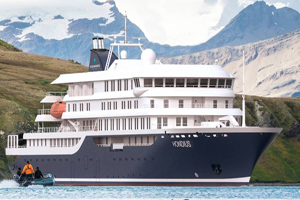 (Click image to view Ship details)
WHAT'S INCLUDED
- Voyage
aboard the indicated vessel as indicated in the itinerary.
- All
meals throughout the voyage aboard the ship including snacks, coffee
and tea.
- All
shore excursions and activities throughout the voyage by Zodiac.
- Program
of lectures by noted naturalists and leadership by experienced
expedition staff.
- Free
use of rubber boots and snowshoes.
- Transfers
and baggage handling between the airport, hotels and ship only for
those passengers on a selection of flights (advised by Oceanwide) from
Longyearbyen.
- All
miscellaneous service taxes and port charges throughout the programme.
- AECO
fees and governmental taxes.
- Comprehensive
pre-departure material.
Excluded
from this voyage
- Any
airfare, whether on scheduled or charter flights.
- Pre-
and post- land arrangements.
- Passport
and visa expenses.
- Government
arrival and departure taxes.
- Meals
ashore.
- Baggage,
cancellation and personal insurance (which is strongly recommended).
- Excess
baggage charges and all items of a personal nature such as laundry,
bar, beverage charges and telecommunication charges.
- The
customary gratuity at the end of the voyages for stewards and other
service personnel aboard (guidelines will be provided).